

Don’t Fall for Newman’s Revenge
Imagine you’ve hired a new man to paint your house who just didn’t work out. He shows up late, splatters paint on the floor, leaves sloppy edges around the trim and then overcharges you.
You’re done.
You fire him.
Then you hire someone who can actually finish the job.
That’s essentially how California’s recall has worked for statewide officers for more than a century. Two questions appear on one ballot: Should this person be removed? And if so, who should replace him? Voters decide whether to fire the official who failed, and they choose the replacement themselves.
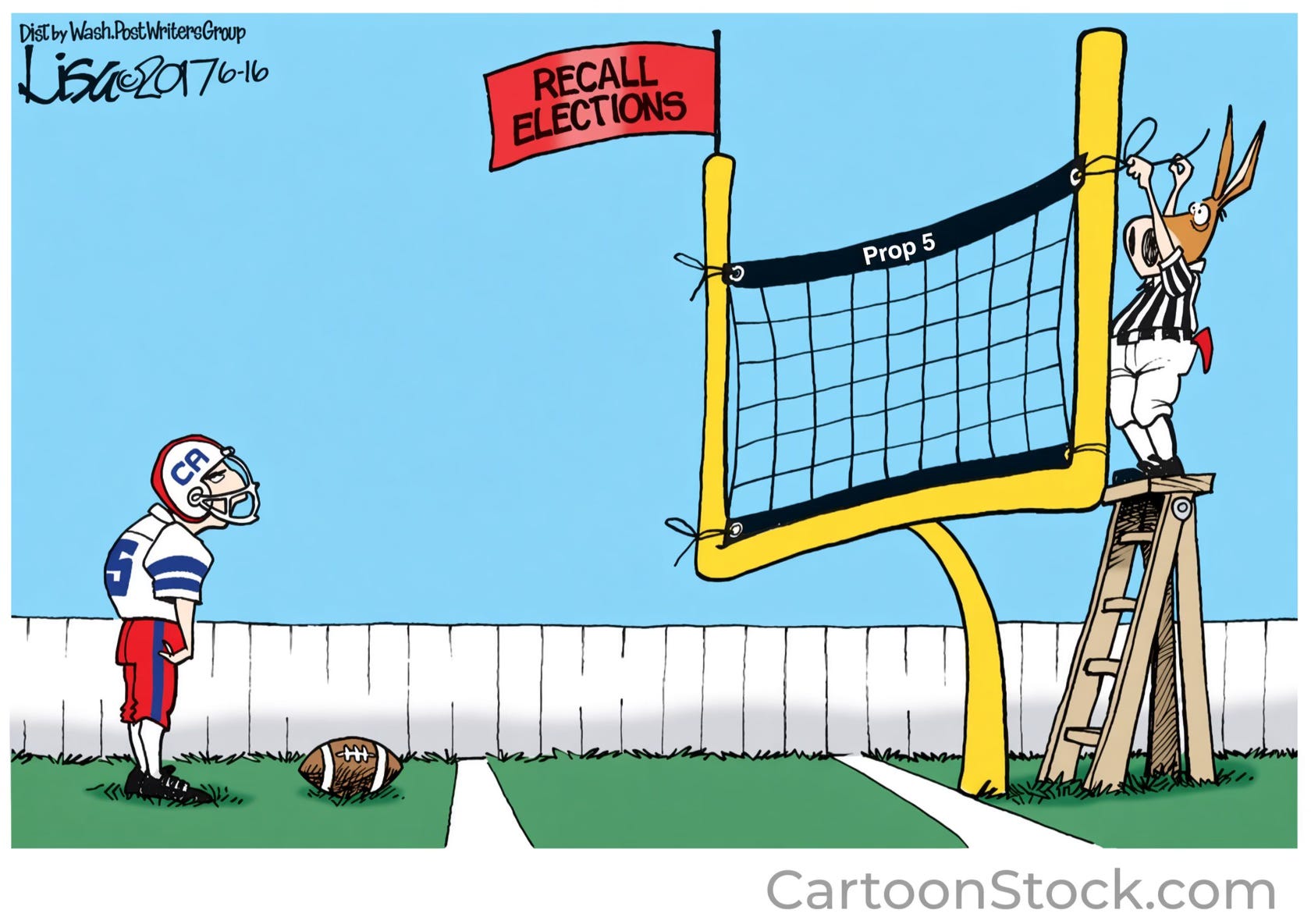
Proposition 5, known as the “Eliminate State Officer Recall Successor Elections Amendment,” would change that. And not for the better. It keeps the first question but eliminates the second. Under Prop 5, if voters recall a state officer, they lose their say in who takes the job next. The recalled official can still run again later, but voters no longer get to name the replacement.
In plain terms, Prop 5 flips the employer-employee relationship. Voters are supposed to be the employers. They hire the politicians. They can fire them. Under the current system they also get to choose who comes next. Prop 5 leaves the firing power in place but takes away the hiring power. The job then goes to whoever the succession rules already point to, the former painter’s brother or cousin, rather than the person the voters may actually want.
Gutting a 100-Year-Old Progressive Reform
Power to politicians rather than to voters was never the recall’s original idea. In fact, it was the reverse. California voters wrote the current recall rules into the Constitution in 1911 as part of Hiram Johnson’s progressive reforms. The goal was to break the Southern Pacific Railroad’s grip and dismantle the political machines that treated public office as belonging to politicians rather than the public. It passed with 76.8% approval.
The recall tool has always been used sparingly. Since 1911 there have been roughly 180 attempts to recall state officials. Only eleven collected enough signatures to reach the ballot, and only six of those succeeded: a couple of Progressive-era senators, two Assembly members in the mid-1990s, Gray Davis in 2003 (replaced on the same ballot by Arnold Schwarzenegger), and Josh Newman in 2018.
Prop 5 was written by Josh Newman, the same Democrat recalled in 2018 over a gas-tax vote. Given Mr. Newman’s infamy, Prop 5 looks like little more than a ham-fisted form of revenge against a system that provided some form of public accountability. Prop 5 is co-authored by Assembly member Isaac Bryan. It has the support of Secretary of State Shirley Weber, Lieutenant Governor Eleni Kounalakis, California Common Cause, the League of Women Voters, and the state Democrat Party.
The Pro Arguments are Wafer Thin
They say the current two-question ballot can produce a replacement who wins with only a plurality, that voters sometimes get confused by the second question, and that the system invites partisan operators to engineer recalls as shortcuts around normal elections.
A crowded field can produce a plurality winner—that is how multi-candidate races often work. The solution is not to take the entire choice away from voters and hand it to succession rules or a later process controlled by the same political class the early 20th century Progressives worked so hard to restrain. Ballot confusion is a real design-and-education problem, not a reason to erase one of the two core decisions. And the claim that the current system encourages frivolous recalls is not supported by the record. Of those nearly 180 attempts, only six succeeded statewide. The high cost of waging a recall is already enough to deter casual operators.
Beyond Mr. Newman’s own recall, the 2003 Gray Davis recall remains the clearest example of the system working as designed. Voters decided the governor had failed, and on the same ballot they chose his replacement, in that case Arnold Schwarzenegger. That is popular sovereignty in action. Prop 5 would have turned that moment into a vacancy filled by the lieutenant governor—then Democrat Cruz Bustamante—or a later election under different rules. The recall was placed in the Constitution precisely because the electorate did not trust the political class to police itself. Prop 5 dials much of that power back toward the political institutions those 20th Century Progressives sought to restrain.
Vote NO on Prop 5: Keep Replacements in the Hands of Voters
Supporters note that most other states fill vacancies by succession or separate election. California’s system was deliberately designed to give voters the final say, not so the existing order could simply continue. When the painter is bad, you should be able to fire him and hire the one you want—not the painter’s brother, not whoever the disgraced incumbent hoped to maneuver into place. That is the point of a recall. Prop 5 dilutes it. It shifts the replacement decision away from the people who just issued the pink slip.
After more than a hundred years, this is not a small procedural tweak; voters should choose a recalled politician’s replacement .
When homeowners or voters feel that a job has been poorly done, they should have the right to replace that subordinate and choose for themselves who best to finish the job.
Don’t let the recalled rewrite the rules that removed them.
Vote NO on Prop 5
Thank you for explaining this so clearly. Is there a way to post this to social media?
It will win on election day and lose a month later after all the fake ballots are counted. Oh So California!