

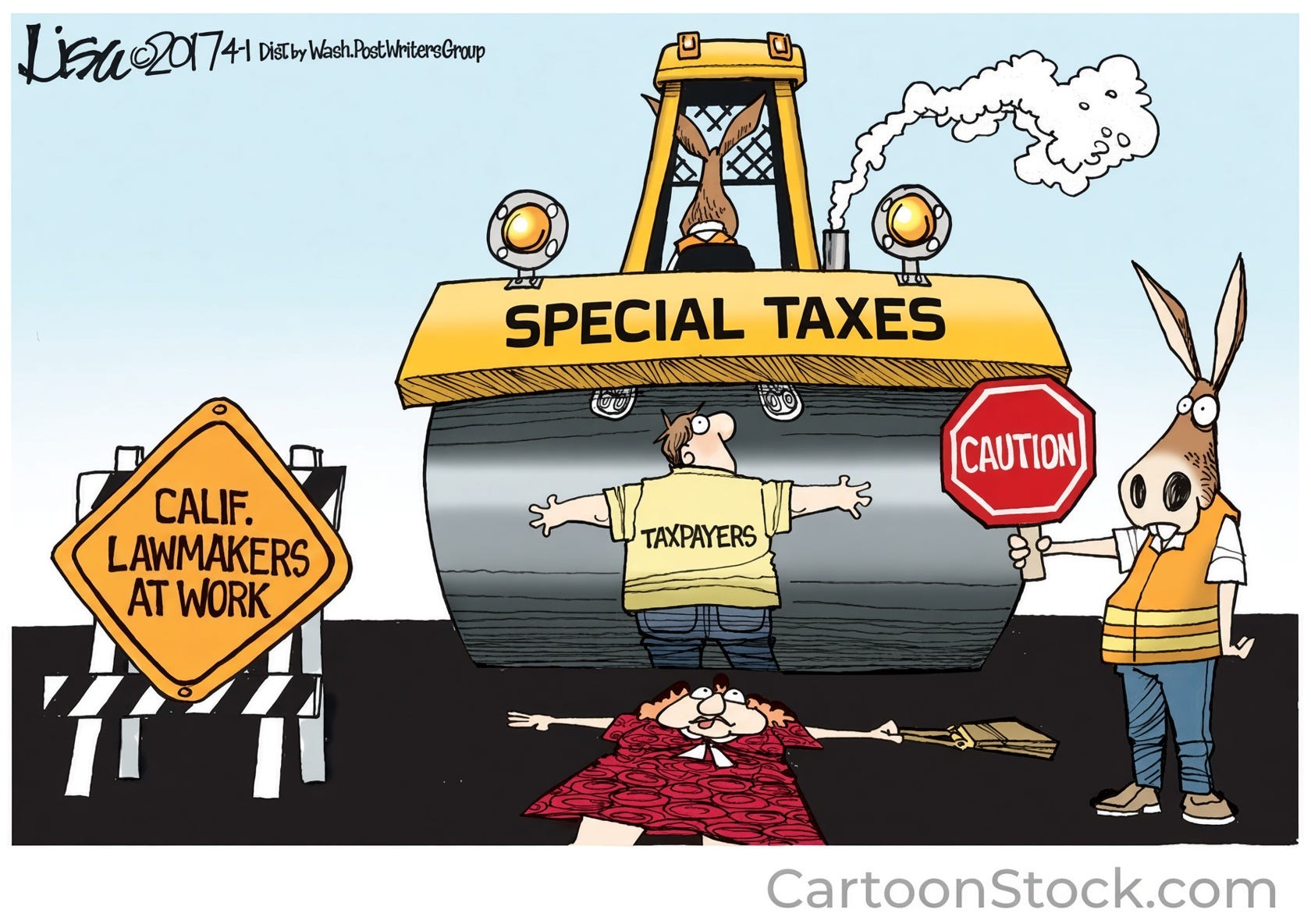
Government always wants another slice of your paycheck. The easiest way is a special tax placed on the ballot under cover of a “citizen initiative.” Proposition 43 would do away with that dishonest development.
California has two kinds of local taxes. A general tax that goes into the general fund and can be (mis)allocated and (mis)spent by our elected officials. Such general taxes are passed with a simple majority.
A special tax is earmarked money that is tied to a named purpose: schools, parks, homelessness, fire, trains, basically anything that sounds good and popular. Before 2017, all special taxes required a threshold of 2/3 majority to pass. Prop 43 would reestablish that 2/3 majority threshold for special taxes.
Voters originally set that higher threshold on purpose. Proposition 13 in 1978, and Proposition 218 later, made a special tax hard to pass. If City Hall wants money locked to one cause, it needs two-thirds of the voters. A school board wants the same? Two-thirds. This higher threshold was based on the fact that earmarked taxes are much easier to sell to the electorate and once sold create constituencies hellbent on their continuation. Taxing you for a dedicated public pot was not meant to be easy.
Yet, California’s courts opened a workaround for special taxes lowering the two third’s threshold to just a simple majority. The 2017 case California Cannabis Coalition v. City of Upland was about a marijuana fee and election timing. Later courts stretched its logic to the vote threshold. File the same special tax as a “citizen initiative,” and a simple majority, 50 percent plus one, can pass it. The purpose stays special. The bar drops to a majority, opening the flood gates to more special taxes that are easy to pass; fifty percent is a low threshold in a state such as California with its massive bureaucracy and where public unions make up a significant bloc that always votes in favor of more spending.
Proposition 43 would end that shortcut beginning on January 1, 2027. Special taxes would again – staying true to the original Prop 13 – need two-thirds majority, no matter who puts them on the ballot.
Return to Prop 13’s Original Intent by Voting YES on Prop 43
The amendment is simple. No one may impose, extend, or increase a special tax without a two-thirds vote. New value-based property taxes would also be barred, except Proposition 13’s 1 percent rate and voter-approved bonds. Cities, counties, special districts, school districts, and community colleges would live under one rule. If the tax is special, it would need two-thirds approval.
Look at who those “citizen initiative” petitioners often are. Not neighbors with clipboards and a playground sketch. Public-employee unions are the main organized funders of city tax campaigns. A University of California analysis of 116 city tax measures found unions giving to 78 of them. On those races they supplied much of the money. Police and fire locals did much of the same self-interested funding when the tax would benefit their members.
Government agencies quickly learned that using “citizen initiative” made tax increases much easier. In San Francisco, a school district and its teachers’ union drafted a parcel tax for teacher pay and classroom staffing. A deputy superintendent edited the language. The union then asked three residents to sign as official proponents. A district-sponsored special tax would have needed two-thirds. The court treated it as a “citizen initiative” anyway.
Virtuous Packaging of Sneaky Taxes
The wrapping on special taxes is always virtuous, even if the outcome is not. Special taxes almost always name a cause few will campaign against, such as teacher salaries. child care, homelessness, fire protection, trauma centers, trains, parks, and community colleges. The deceptive wrapping is cynically used to make it easier to reach into your pocket.
It is worthy to note that what appears on the ballot as Proposition 43 is a watered-down version of the measure Howard Jarvis’s allies first filed. That version restored a two-thirds vote and reached back into special taxes already passed by simple majority. Assemblymember Buffy Wicks (D, Oakland) wrote the weakened replacement that let previously approved majority-vote special taxes stand. She shepherded it through the legislature where it passed 68–2 and 35–1. She then flip-flopped and urged Californians to reject the very amendment she had authored. The Democrat supermajority undermined Jarvis’s taxpayer stronger initiative. Then they walked away from the compromise that replaced it, in the cynical hope that special taxes continue to be easy to pass in California.
Proposition 43’s official title builds on the legislature’s deception. In 1978, Proposition 13 was objectively described as a “tax limitation” on the ballot because that is what it was. This year, Attorney General Rob Bonta completely turns the Proposition 43 ballot wording upside down by labeling it a “voter limitation” by inserting this statement on the ballot: “Limits Voters’ Ability to Raise Revenues for Local Government Services.”
The Prop 13 title named it a restraint on government. The Prop 43 title implies a loss for the public. Bonta’s creative writing does not mention a two-thirds threshold. It does not mention special taxes. It invites you to think you – not City Hall – are being limited.
Vote YES on Prop 43.
California is not an undertaxed state. California’s local governments already rank among the highest funded in the country. Lincoln Institute figures for 2023 put local general revenue here near $10,600 per person. The national average is about $6,900. Only New York’s local governments collect more.
At issue is whether another dedicated claim on your income must clear a 2/3 supermajority of voters or only a majority assembled by the special interest groups that often spend the money to benefit themselves.
Push back on the legislature’s deceptive attempt to make it easier to tax so their local minions can continue to overspend your hard-earned tax dollars.
Protect yourself.
VOTE “YES” ON PROP 43.
Thank you for your explanations of the ballot measures. Normally I just vote NO on all of the propositions just because they are worded so poorly and look like they are trying to bundle too many new rules into one vote. I will follow your lead now.
Thank you for writing this article.