
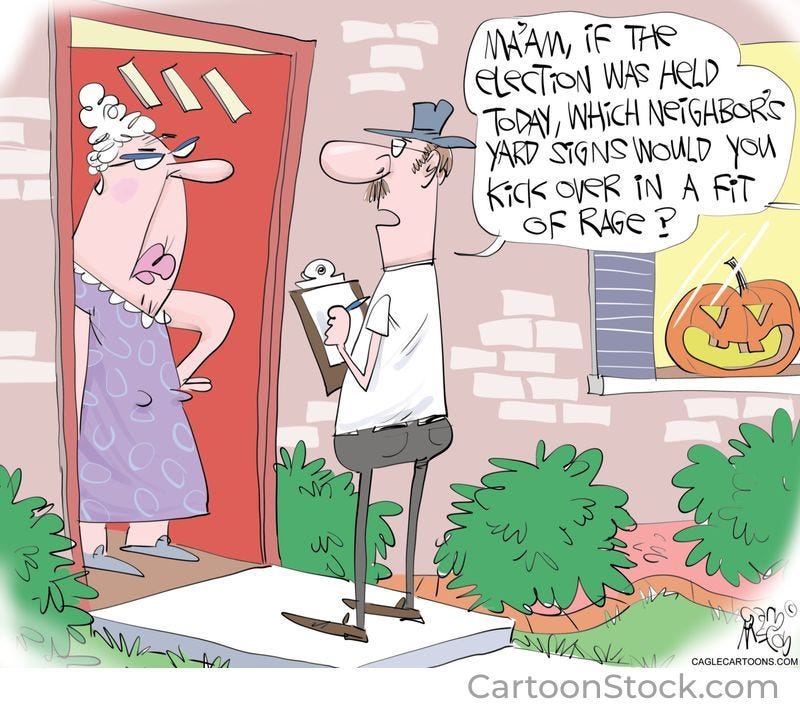
In the current election cycle the admonition of “don’t trust the polls” has particular resonance. Whether fair or not, there is a perception that most polls are motivated by attempts to affect the outcome of an election as opposed to fairly assessing voter sentiment. Indeed, the most recent scandal involved Wedgewood Polls, a self-labeled polling firm that ultimately admitted that its polling data was entirely fabricated.
When Fake Data Meets the Aggregators
Even if there were suspicions about the Wedgewood firm, the problem is that their polling “results” were included in media reports that employ aggregation. When bad polling is “aggregated” with legitimate polling data, it skews the results. According to the National News Desk, “Despite having no history, formal credentials, or real data behind the vast majority of our releases, Wedgewood Polling was added to major polling aggregators, including The New York Times, FiftyPlusOne, and VoteHub, and repeatedly treated as a legitimate data source.”
Even the Pros Can Blow It
While questionable polling can be expected from questionable polling firms, the same is not true for respected pollsters with proven track records. That’s why a Des Moines Register poll conducted by J. Ann Selzer in 2024 was described as a “bombshell.” It showed Kamala Harris carrying the state by three points over Donald Trump. After Trump won the state by 13.2 points, the reputation of the Des Moines Register took a blow and Selzer was forced into retirement.
Useful Tools, Not Crystal Balls
As active participants in California politics we know that polls are not only useful, but indispensable for measuring voter sentiment, assessing the strength of arguments for and against, and message testing. But we are also aware that in a progressive state such as ours polling on conservative causes in general, and fiscal issues more specifically, come with their own challenges.
Proposition 13: The Pollsters’ First Big Miss
The evolution of polling results on Proposition 13 in 1978 provides a case study in shifting attitudes. Just after Howard Jarvis filed over 1.2 million signatures in early 1978, California voters were deeply divided with early polls indicating support around 25%, opposition at 27% and nearly half of all voters undecided. By Spring, when homeowners began receiving their property tax bills, there was a major uptick in support with a plurality in favor. Although the writing was on the wall, even the last Field Poll taken just before the June 6 primary significantly understated support by projecting Prop 13 passage by an approximately 57% to 60%. The actual margin was 64.8% to 35.2%.
Proposition 218: From Dead in the Water to Victory
By far the starkest example of a polling misfire was with Proposition 218, another tax reform measure sponsored by HJTA. Leading up to the election on November 5, 1996, polling for California’s Proposition 218 consistently showed the measure failing badly. In the final Field Poll released right before the vote, Prop. 218 was garnering a measly 36% of likely voters. But despite the negative polling, Proposition 218 defied all expectations and sailed to victory with 56.55% support.
Proposition 5: The Pattern Continues
Finally, and most recently, polling was off by about 5% on Proposition 5, an effort by the progressives in the California Legislature to reduce the vote threshold for some local bonds from two-thirds – a constitutional requirement since 1879 – to 55%. Just prior to the election, the Public Policy Institute of California poll reported that, “Likely voters are divided on this legislative constitutional amendment, with 49 percent saying they would vote yes and 50 percent saying they would vote no.” But Prop. 5 failed by over 55% to 45%.
The Quiet Taxpayer Effect
The review of polling results on ballot measures related to Proposition 13 and its progeny show that the discrepancies between the polling and the actual results tend to undercount taxpayer interests. This is not to suggest that these differences were intentional. But perhaps they reveal that many voters, including those who do not consider themselves to be taxpayer activists, either don’t respond to polls or prefer to conceal their fiscal conservatism.
The Only Poll That Matters
Thus, the real question is not whether polls can be trusted. It is why any voter would allow polling data to impact their decision on whether to vote. Because the only poll that counts is the one on election day.
Jon Coupal is president of the Howard Jarvis Taxpayers Association
****
Go to your polling place today and vote, or forever hold your peace.
This is the last day you can vote: Tuesday, November 3rd General Election.
Looking for common sense guidance on your ballot? Check out California Current’s proposition guide and Statewide Candidate recommendations - written from the only point of view that actually pays the bill: the overworked, under-appreciated California taxpayer.
We don’t hand you a cheat sheet and walk away. Every recommendation is backed by clear-headed research. Click the links below, read the case, then mark your ballot with your eyes open.
NO on 1. The Con Job
NO on 2. Supersizing California’s Slush Fund
NO on 3. The Forever Tax
NO on 4. Your Money, Their Campaigns
NO on 5. Recall Revenge
NO on 37. Robin Hood in Reverse
NO on 38. Pork Barrel Science
YES on 39. Trust, but Verify
NO on 40. Tax Billionaires Today, Tax Everybody Tomorrow
YES on 41. Sergey’s Silver Bullets
YES on 42. Sergey’s Silver Bullets
YES on 43. Stop Getting Steamrolled by Special Taxes
NO on 44. Bleeding Health Clinics Dry
YES on 45. Pondering Prop 45
Note: Props 41 and 42 share one article.

Governor: Steve Hilton
Lieutenant Governor: Gloria Romero
Secretary of State: Donald P. (Don) Wagner
Controller: Herb Morgan
Treasurer: Jennifer Hawks
Attorney General: Michael Gates
Insurance Commissioner: no endorsement
State Superintendent of Public Instruction: Sonja Shaw
*******
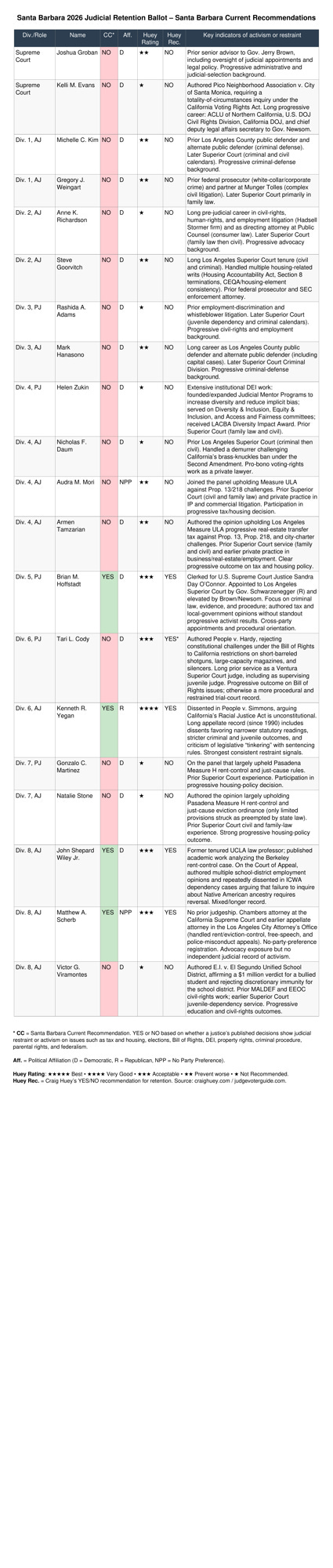
Need a little help with the 20 judicial retention choices for the Second Appellate District (Los Angeles, Ventura, San Luis Obispo, and Santa Barbara Counties)? Click here.
I agree polls are useless. If you want to see who is leading prediction markets offer a better view. We can see what the crowds are thinking and where people are putting their money. Nothing is full proof but I do want to see how accurate those markets got this election.
The entire election system is corrupt, just like every other system. Big money pays for MSM advertising, brainwashing students, confusing propositions, misappropriated money, illegals voting, foreign parts in vote tally machines, bought off politicians and lawyers...goes on and on. Gotta shut it ALL down.