

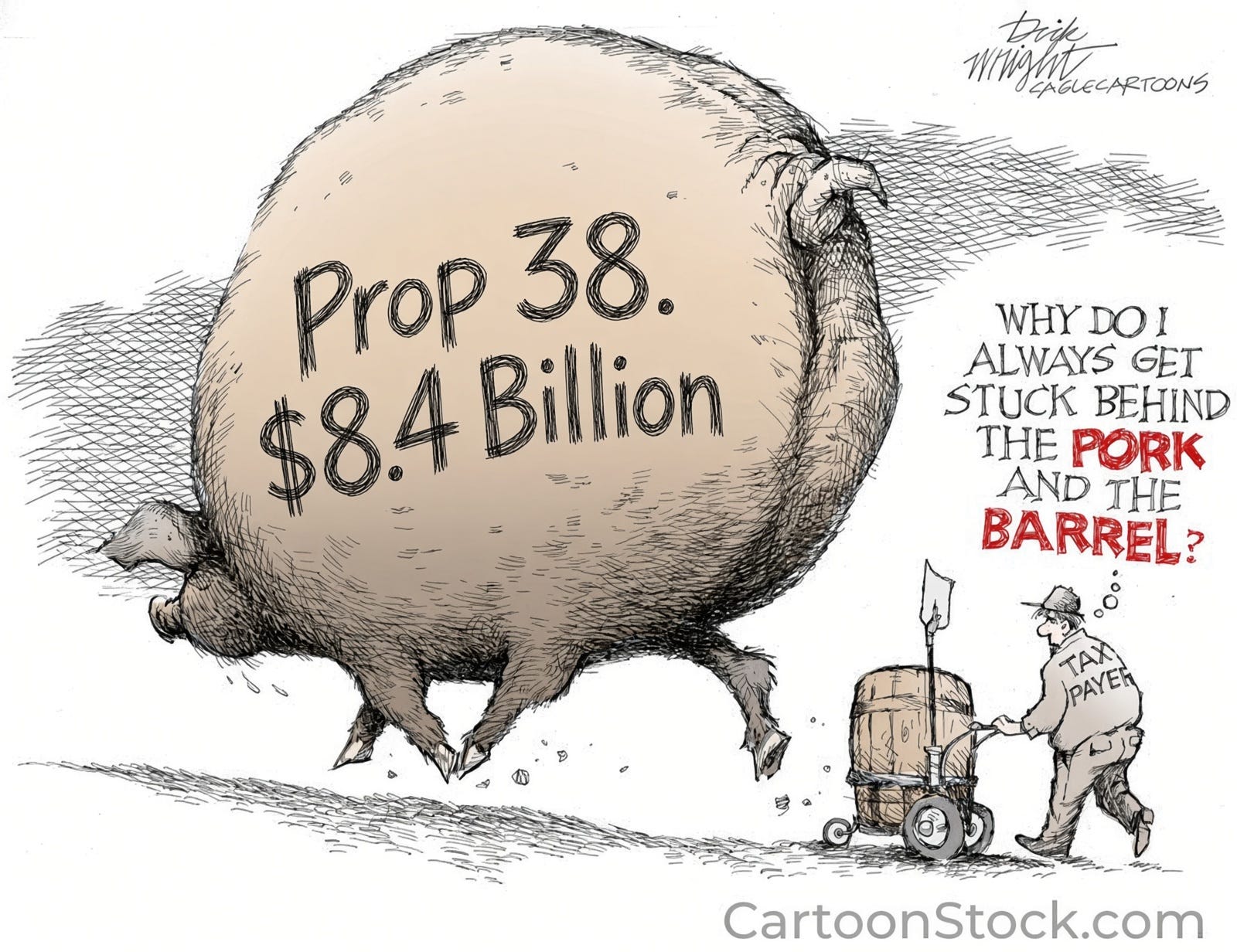
Prop 38: Making the Really Rich Richer… On the Public Dime
This proposition asks taxpayers to put $8.4 billion on the state credit card so a tight circle of ultra-rich founders can supercharge an institute they have already built. The diseases they name are real: Cancer, heart disease, and Alzheimer’s, wreck lives, and immunotherapy is a serious field; nobody serious should pretend otherwise, but that does not make this a good use of public debt.
The question on this ballot is not whether those illnesses matter. It is whether California taxpayers should mortgage the General Fund for two decades to fund research that private capital and philanthropy is already doing.
The CA Legislative Analyst Office says the state would pay $500 million to $600 million a year for about 20 years to retire the bond. About half the proposed Prop 38 proceeds, more than $4 billion, is effectively reserved for a single UCLA-affiliated nonprofit called the California Institute for Immunology and Immunotherapy, or CIII. The measure does not name CIII directly. Instead, it sets eligibility rules that, according to an official at UCLA, only CIII currently meets.
CIII’s co-founders are Gary Michelson, Meyer Luskin, Eric Esrailian, Arie Belldegrun, Michael Milken, and Sean Parker. On the Fair Political Practices Commission’s top-contributor list, Michelson, his affiliated Michelson Center for Public Policy, and Luskin, account for $26.2 million behind “Yes on 38” committee contributors.
Spending millions to steer more than $4 billion in grants to one’s institute is a novel use of the California initiative process.
CIII is built to develop therapies and intellectual property that can then be licensed to outside companies. Under Prop 38, taxpayers are asked to put up billions in cash but have little claim on any benefit. Under the measure, the first 10 percent of income from that research goes to the General Fund to help repay the bonds.
Ten cents on a dollar is not a partnership.
It’s a tip, and a paltry one at that.
Q. With billions at risk, thin oversight, and very limited upside, would any of these CIII co-founders be taking the taxpayer’s side of that trade?
A. Not bloody likely.
Voters shouldn’t take it either.
Private capital already funds much of this important work, and does so better at the treatment and therapies stages Prop. 38 targets. Private research and development spending worldwide on cancer, heart disease, and Alzheimer’s already runs well over $150 billion a year. Industry originates about 90 percent of FDA approved products and spends an order of magnitude more on clinical development than government does. When a private program fails, the money stops and moves to whatever is more likely to work.
There is no evidence that public bonding produces more or cheaper cures. If Prop. 38 passes, $8.4 billion is designed to flow to CIII, the UCs, and other eligible entities whether results arrive or not. The General Fund keeps paying whether progress is made or not.
And if history is any guide, expect not.
We’ve Seen this Movie Before
In 2004, Proposition 71 borrowed $3 billion for stem-cell research, and voters were sold on the likelihood of a royalty stream that never arrived. The campaign fantasized about hundreds of millions coming back, even a billion or more.
In 2020, Proposition 14 added another $5.5 billion. More than 20 years after Prop 71, taxpayers have seen about $17.6 million in royalties. The two bonds cost about $14 billion, once interest is included.
That money did not produce a stack of FDA-approved products.
It did not deliver the marketed cures for Alzheimer’s, cancer, heart disease, or diabetes.
It just further indebted California.
Public-private bond measures like Prop 38 make big, emotional promises, but all they do is burn billions in tax money.
If the state is lucky, it gets pennies for dollars and little progress. If unlucky, zilch, and taxpayers are on the hook for it all.
Millions of well-intentioned voters will read Prop 38’s title – “Authorizes Bonds for Immunology Medical Research. Initiative Statute.” –and mistakenly think they are helping cure cancer. Absent any organized opposition to this Proposition, most voters will not know that most of the financing is already private and far more effective. It is private capital which makes the most dramatic headway in the battle against these diseases, not government grants and largess to connected insiders.
If Prop 38 passes, taxpayers will be shoveling billions in grants toward an institute founded and chaired by the same people funding the campaign.
The other half of Prop 38 funding will likely go to many of the same UC nonprofits and academic recipients upon whom billions in stem cells funding has already been spent.
Heads, they get the benefits.
Tails, you get the bill.
Vote NO on Proposition 38.
I have always voted NO on bond measures. Use the money you already have! Might this have anything to do with the federal government pulling back on grant money? I could see supporters of this blaming the federal government. I sure wish more people did their research before voting for all this garbage.
If its such a great idea, why can't they get the uber-rich of Hollywood or Silicon Valley to fund it?