

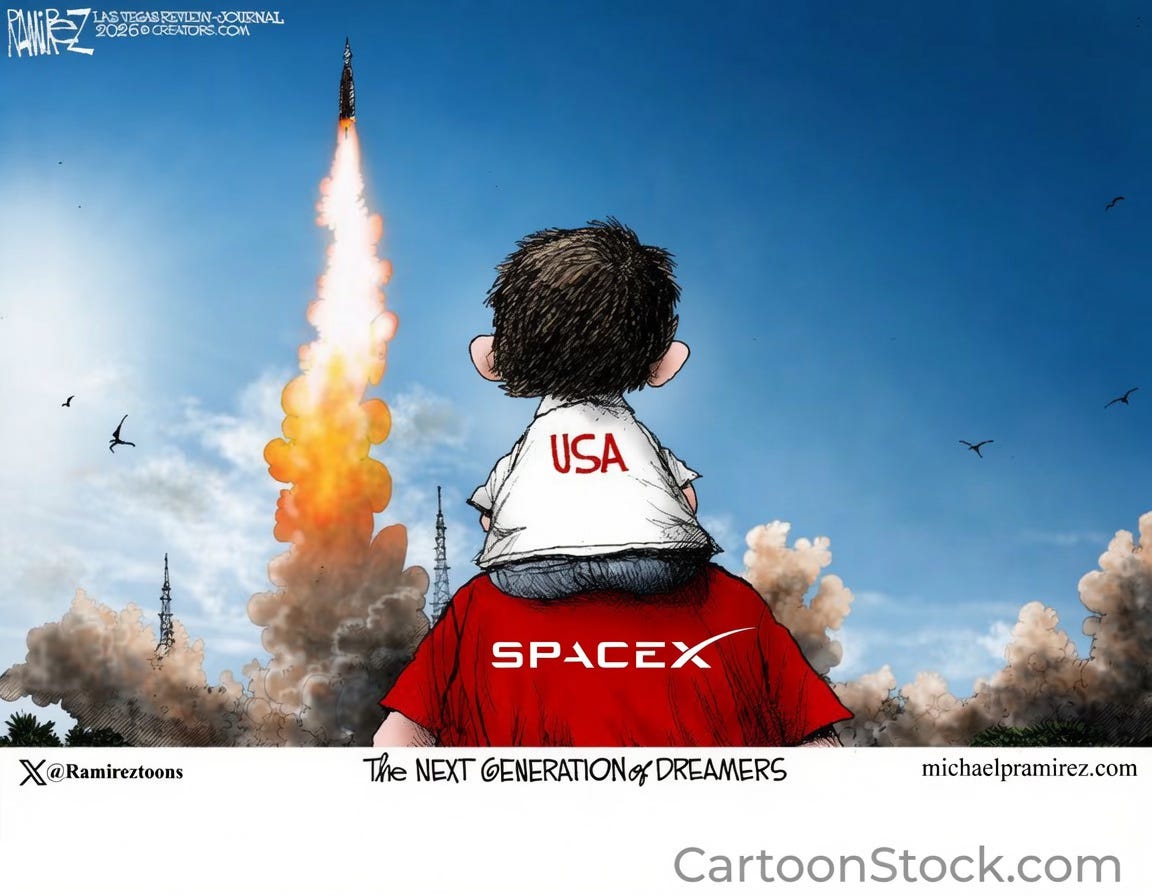
When SpaceX went public, much of the media focused on one headline: Elon Musk became the world’s first trillionaire.
It is a remarkable achievement and certainly newsworthy. But I believe most of the media missed the much bigger story. According to reports, approximately 4,400 SpaceX employees became millionaires through company stock ownership.
Think about that for a moment.
Not 4,400 venture capitalists. Not 4,400 hedge fund managers. Not 4,400 Silicon Valley executives. The 4,400 employees included not only scientists and engineers but also welders, electricians, machinists, technicians, mechanics, and quality inspectors. They were the skilled tradespeople who helped build one of the most advanced manufacturing companies in human history.
That is the real American Dream story, and it is the one we should be talking about.
For decades, America created wealth this way. The auto, aerospace, shipbuilding, defense, and computer revolutions, generated prosperity that spread far beyond corporate boardrooms. Engineers, technicians, and skilled laborers shared in the success of the companies they helped build.
Somewhere along the way, we began treating manufacturing as yesterday’s economy and software as tomorrow’s. SpaceX brings us back to our American roots. Unlike many Silicon Valley success stories, SpaceX doesn’t simply write code. It builds things.
Every one of those activities requires thousands of skilled workers. As an engineer, my job was never to replace skilled labor. My job was to make skilled labor more productive. I have worked on the nation’s most complex defense systems. During my Navy career, I led teams supporting ballistic missile defense missions that launched multiple test vehicles into space. I have worked alongside the country’s brightest engineers.
I have also worked alongside thousands of technicians, mechanics, electricians, welders, quality inspectors, logisticians, and skilled tradespeople who made those missions possible.
A billionaire doesn’t build a rocket.
A software engineer doesn’t build a rocket.
A rocket is built by a team.
That relationship between engineering and skilled labor made America the most technologically advanced nation on Earth.
Scientists discover.
Engineers design.
Technicians implement.
Skilled labor builds.
When all four work together, extraordinary things happen. That is why California should pay attention to what is happening around us. California remains one of the world’s great innovation centers. We still have extraordinary universities, venture capital, entrepreneurs, and talent. We helped invent the modern technology economy.
But leadership is never permanent. Tesla moved its headquarters to Austin, and SpaceX moved its headquarters to Texas. While important manufacturing remains in Hawthorne today, nearly all of SpaceX’s major new investments, including Starship, Starbase, and the company’s headquarters, are occurring in Texas. California should not assume tomorrow’s manufacturing will automatically remain here.
An increasing number of manufacturing, energy, and technology companies are choosing to expand in states that are actively competing for industrial investment. The question is not whether California will continue producing ideas. The question is whether California will continue producing things.
Innovation creates inventions. Manufacturing creates middle-class wealth.
We launch rockets from Vandenberg. We have UCSB. We have Cal Poly. We have one of the nation’s best skilled trade workforces. We have aerospace expertise, defense infrastructure, and venture capital, just a few hours away. If any place in America should become the next center of aerospace and advanced manufacturing, it should be the Central Coast.
We are the launchpad for someone else’s prosperity, while much of the economic opportunity is being created elsewhere.
We are watching other states aggressively compete for those opportunities. Austin is increasingly positioning itself as a challenger to Silicon Valley. Texas is not just attracting headquarters. It is attracting factories, manufacturing, investment, and talent.
California is approaching an economic tipping point.
We can continue making California less competitive for advanced manufacturing, energy, and industry, or we can recommit to producing things.
The future of manufacturing is not yesterday’s smokestacks. It is clean rooms, robotics, aerospace, semiconductors, and advanced energy.
The lesson of SpaceX is not that Elon Musk became ultra-wealthy. The lesson is that 4,400 employees became wealthy alongside him. Unlike many Silicon Valley IPOs, in which much of the wealth accrued to founders, executives, and software engineers, SpaceX created extraordinary wealth for a much broader manufacturing workforce, including skilled trades.
We did not even court SpaceX to build manufacturing facilities here on the Central Coast, even though we conduct nearly 100% of their polar orbit launches.
Think about what that means:
A welder paid off his mortgage.
An electrician sent a daughter to college debt-free.
A machinist started a small business.
A technician became financially independent.
A young family bought its first home.
That is what happens when America makes things.
California did not become the world’s technology leader by accident. We earned that position by producing the technologies, products, energy, and industries that changed the world. The question is not whether we still lead today. It is whether we are making the decisions that will allow us to keep leading tomorrow.
Otherwise, we will keep launching someone else’s future.
•••
Bob Smith is a retired Navy veteran and candidate for California’s 24th Congressional District.
Excellent post!
I'm a Native Californian and 1st Generation American. I joined the US Air Force as a Junior in High School (DEP - delayed enlistment program). My recruiter helped me pick an awesome AFSC (Doppler, Inertial, and Celestial Nav Systems) as my goal was to learn electronics (family couldn't afford to send me to Cal Berkeley or anywhere else), work on planes (my first love), and serve my country during the Cold War (my Dad served during WWII in the RAF). A great start - from AFSOC in W. Germany (Rhein Main AFB), to SACHQ in Omaha NE (Offutt AFB), then NRO in Marysville CA (Beale AFB - SR-71 & U-2).
My career progressed from hardware, to firmware, to software. 15 startups later, I became a "thousandaire" - never landed the big money (no bitterness, just a fact). But I enjoyed every minute.
I am 100% in agreement with you that what Elon did is a huge shift! He BROUGHT EVERYONE WITH HIM, not just a bunch of VCs who ultimately cash in, alone... the VCs always believe it was their "risk-reward" yet we did the work.
Elon knows: it takes everyone to succeed.
California, my home state, has tarnished and taxed the American Dream right out of this state. Sad.
Thank You for your post. Sadly, we've offshored the American Dream, and we need to get back to making things again...
Thanks Bob for this very well written article!
Think any of our Elected Officials would have written an article like this, negative!
It’s because of our Elected, doing business in California has moved to a more friendly business state taking thousands of high paying jobs with them.
We need you Bob to help our State turn this disaster around!