

Slippery-Tongued Newsom is For and Against the Billionaire Tax
Once every millennium, the Current agrees with Governor Newsom on a very important issue facing California voters. This time we both agree that Proposition 40 – the wealth tax on billionaires in California –, should be defeated by the voters on November 3.
But not to get too soft-hearted about this newfound agreement with Newsom, since he only cares about losing the goose that laid the golden eggs in this state, which is the likely mass exodus of billionaires from California if this insane proposition passes, so he opposes it for California. However, he is in favor of a wealth tax for the entire country.
For any reader not up to date with this groundbreaking referendum, Proposition 40 would impose a one-time (hah, hah) 5% wealth tax on California billionaires, payable in annual instalments of 1% over five years (with a deferral charge). The tax is based on the worldwide net worth of taxpayers valued as of December 31, 2026.
There are so many problems with this tax we almost don’t where to begin to cite them all. The proposition was foisted upon us by the Service Employees International Union (SEIU), a major labor union in California.
Rather than get into minutiae of all the difficulties, maybe it would be instructive to look at which countries have gone down this road before and what subsequently happened after imposing the tax.
Before we do, it is important to note that no state in the United States has ever had a wealth tax, since the tax would likely be declared unconstitutional by virtue of retroactivity, along with apportionment issues. However, a few countries have had a wealth tax, such as France, Germany, Sweden, the Netherlands, Austria, Denmark, Finland, Iceland, Luxembourg and Argentina. Can you guess what they all had in common? If you answered the tax was repealed in every one of these countries, you would be right. It was repealed because of capital flight, brain drain, high administrative and valuation costs and, lastly, because of disappointing revenue yields.
But rather than discuss the many inherent hurdles the state would have to overcome to levy this tax, we prefer to look at the big picture or the most important part of why this would be such a fundamental change for our country. First, this is an attack on our economic freedoms and private property rights, which has been the greatest driver of economic prosperity and wealth for the greatest number of people since the emergence of Homo Sapiens.
Defeating the Magic of Innovation and Hard Work
To understand why, it is important to look at how these billionaires accumulated their wealth and how it impacts everyone if we should impose a system that attempts to confiscate some of it. In case you weren’t aware, the billionaires’ wealth didn’t magically appear one day. Most of them started a company that provided goods or services that were inherently valuable, so much so that people were willing to exchange their own wealth to acquire or consume their products.
This free or voluntary exchange of resources has led to unprecedented poverty reduction over the last two centuries, as well as rapid technological innovation, consumer abundance and choice, and individual and economic freedom.
If you think we are overstating the benefits of free market wealth creation, all you need to do is examine the inverse, which is state socialism that has resulted in chronic shortages of consumer goods, lack of innovation, economic stagnation, and political repression.
We can already hear from our detractors that we are overstating our case since all we are talking about is taking a very small amount of the wealth these billionaires have amassed. This is the same reasoning supporters of the 16th Amendment gave which resulted in the establishment of our federal income tax system. The first tax was only 1% on those considered the very wealthy at the time. Over the years that metamorphized into a much higher tax. During the 1940s and ‘50s it was in the 90 percent range until it was reduced to 70% in 1965.
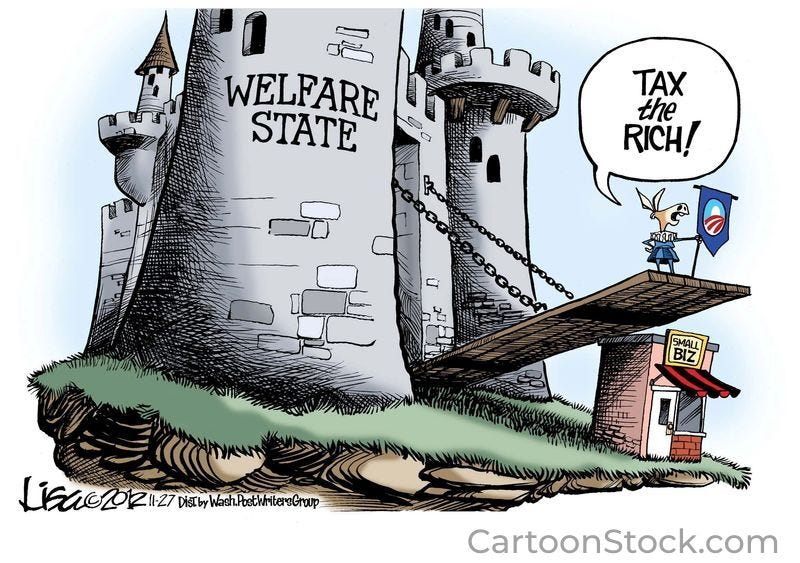
A billionaire wealth tax today would become a wealth tax on all of us very quickly if history is any guide.
Vote NO on Proposition 40
Confiscating wealth is an attack on our economic system and freedoms and would be a slippery slope as it opens the door to confiscation of private property and ultimately would diminish the incentive to create wealth, the very heart of the invisible engine that drives risk-taking and innovation. No matter how angry you may be over the unequal distribution of wealth, don’t cut your own throat by voting for this proposition.
We need to consign this tax to the dustbin of history by voting NO on Proposition 40.
We have a civil war coming between tax and spend government(s), public employees and the left wing politicians vs. business and the tax paying public. Taxing wealth is a loser as are the highest tax rates on income, fuel, etc., in the country, but the fundamental questions are (1); What are we getting for the high tax rates we are already paying for today?, and (2); where is the money planned to be spent by the proponents of this outrageous wealth tax? The answers are, (1), nothing and at great cost, and (2); further bloating of social programs (e.g., DEI, education administration, public universities whose administrations have run far off the rails encumbering students with debt that will never be repaid in return for degrees with no economic value to the real world, overpaid government employees doing worthless tasks regulating businesses to death, etc.) while rocket fueling the already huge unfunded pension liabilities for all these worthless, no value added, public employees. Oh, and of course a bunch of public employees will be needed to administrate this proposed new shakedown program and nothing will be spent on infrastructure. The tipping point is rapidly drawing near. Vote NO on this ridiculous proposition and then take a chainsaw to drastically reduce our current government(s).
A wealth tax is obviously a bad idea. And so is a property tax, which inordinately impinges on the middle classes who depend on their homes for shelter and wealth creation. As my friend Greg Hammel has pointed out recently, the wealthy classes wealth, when combined is only a few trillion. But the middle classes combined wealth is around $180T. So we will be the target for sure if the labor unions and democrats in general get their way.