

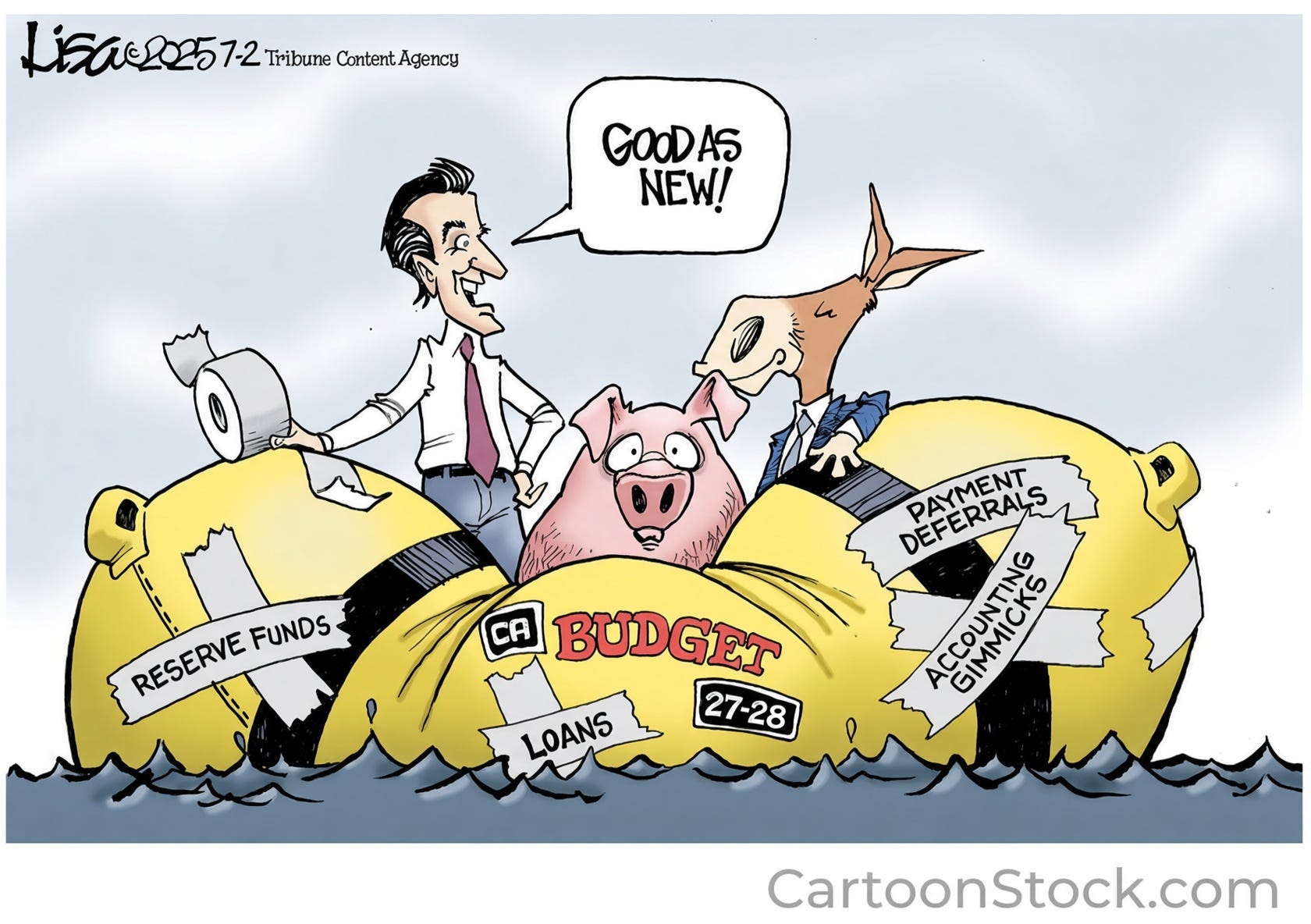
Gavin Newsom is leaving quite a legacy.
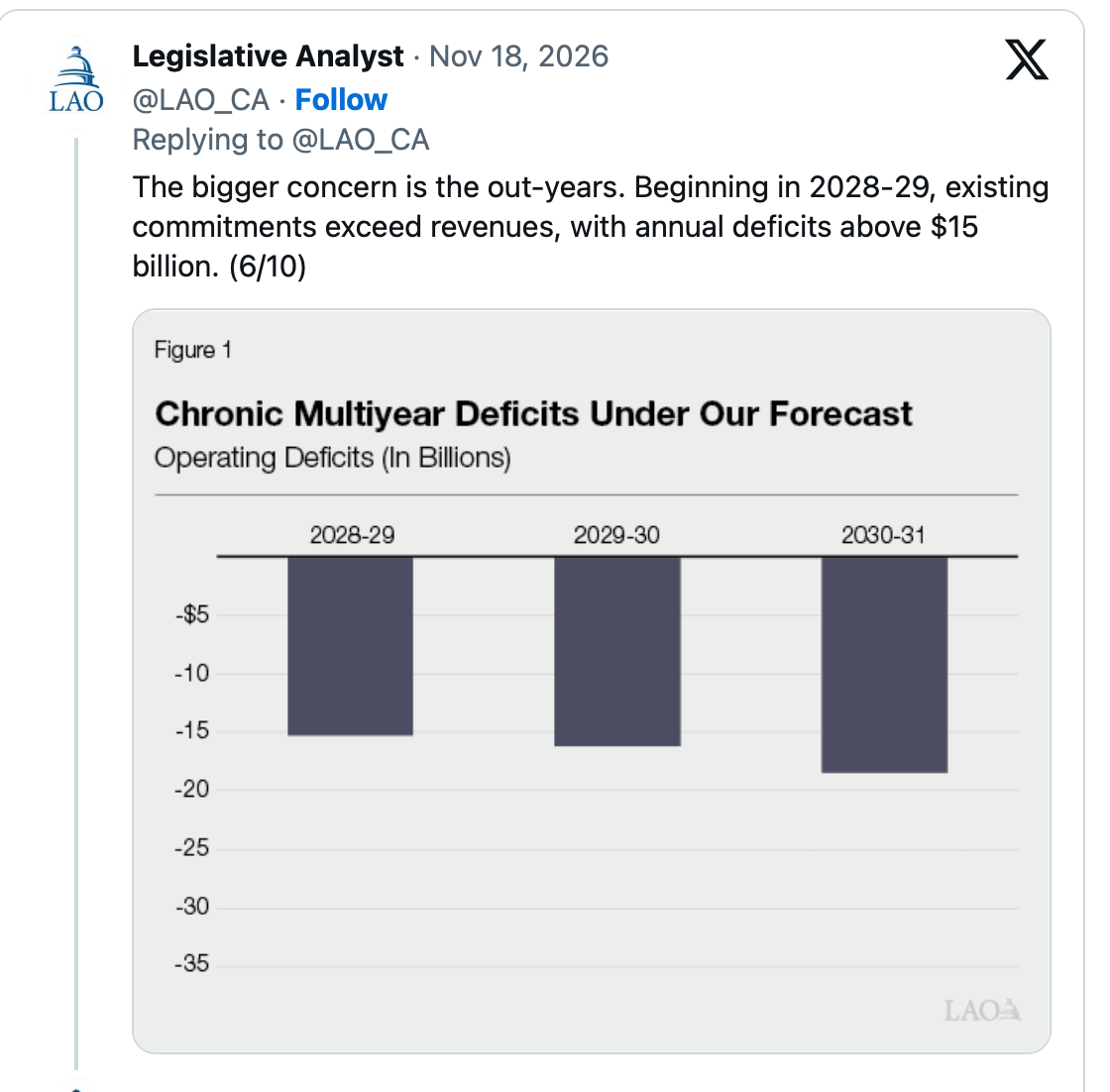
California faces chronic multiyear deficits, the nonpartisan Legislative Analyst’s Office warned in its newly released 2027-28 fiscal outlook, as existing commitments exceed projected revenues.
A few highlights:
Chronic multiyear deficits
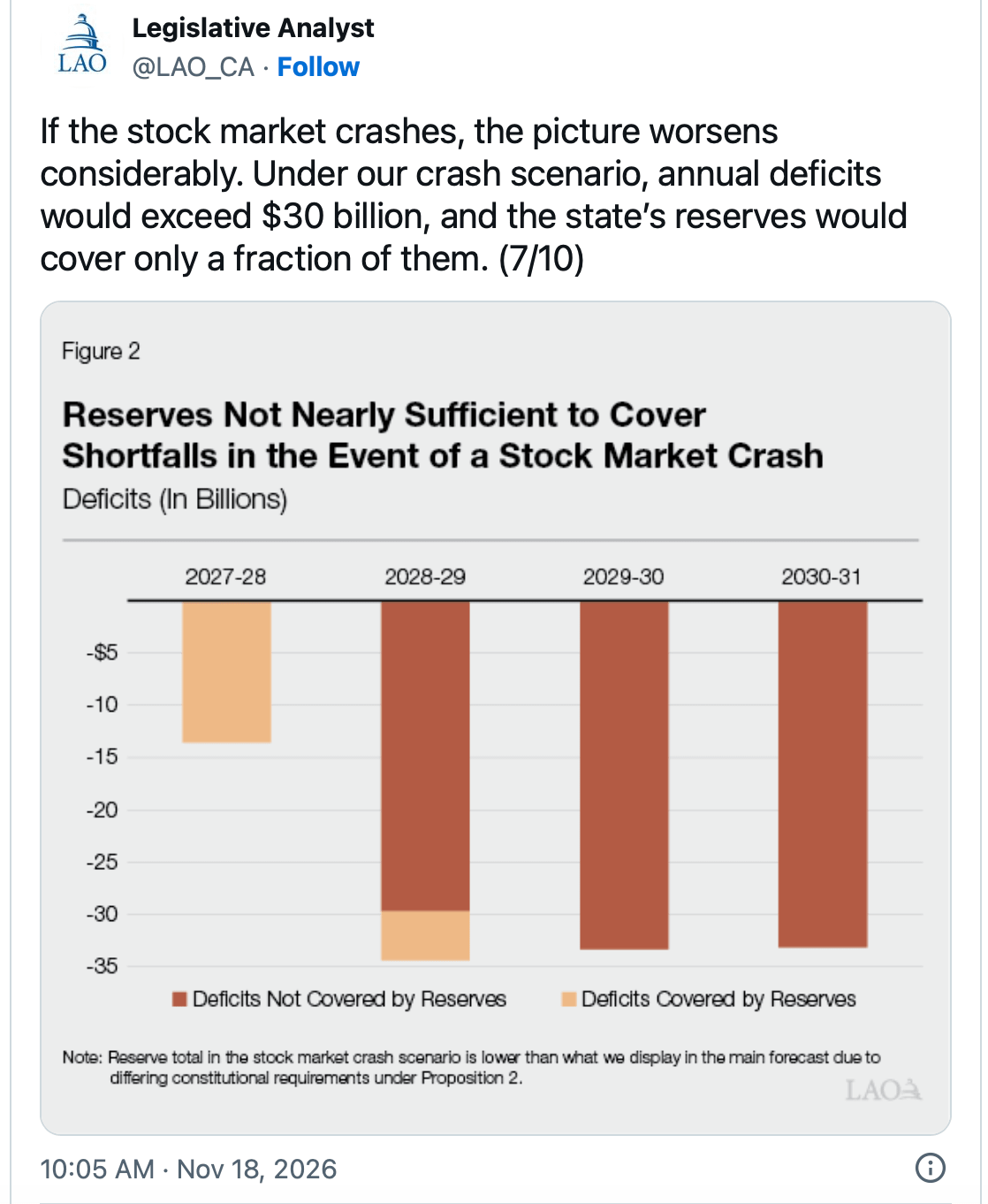
Reserves not nearly sufficient to cover shortfalls in the event of a stock market crash
Existing Commitments Exceed Revenues
Budget Resilience Has Already Been Depleted
Crash Scenario Would Require Significant Actions Over Several Years
This is the fifth consecutive year the LAO has identified multi-year budget problems. Recent revenue strength has improved the near-term picture relative to prior outlooks, but constitutional requirements (Proposition 98 for schools/community colleges and Proposition 2 for reserves/debt) absorb much of any upside, and spending commitments continue to outpace sustainable revenue growth. The report also notes limited remaining budget resilience (rebuilding reserves, residual debt, fewer easy one-time cuts).
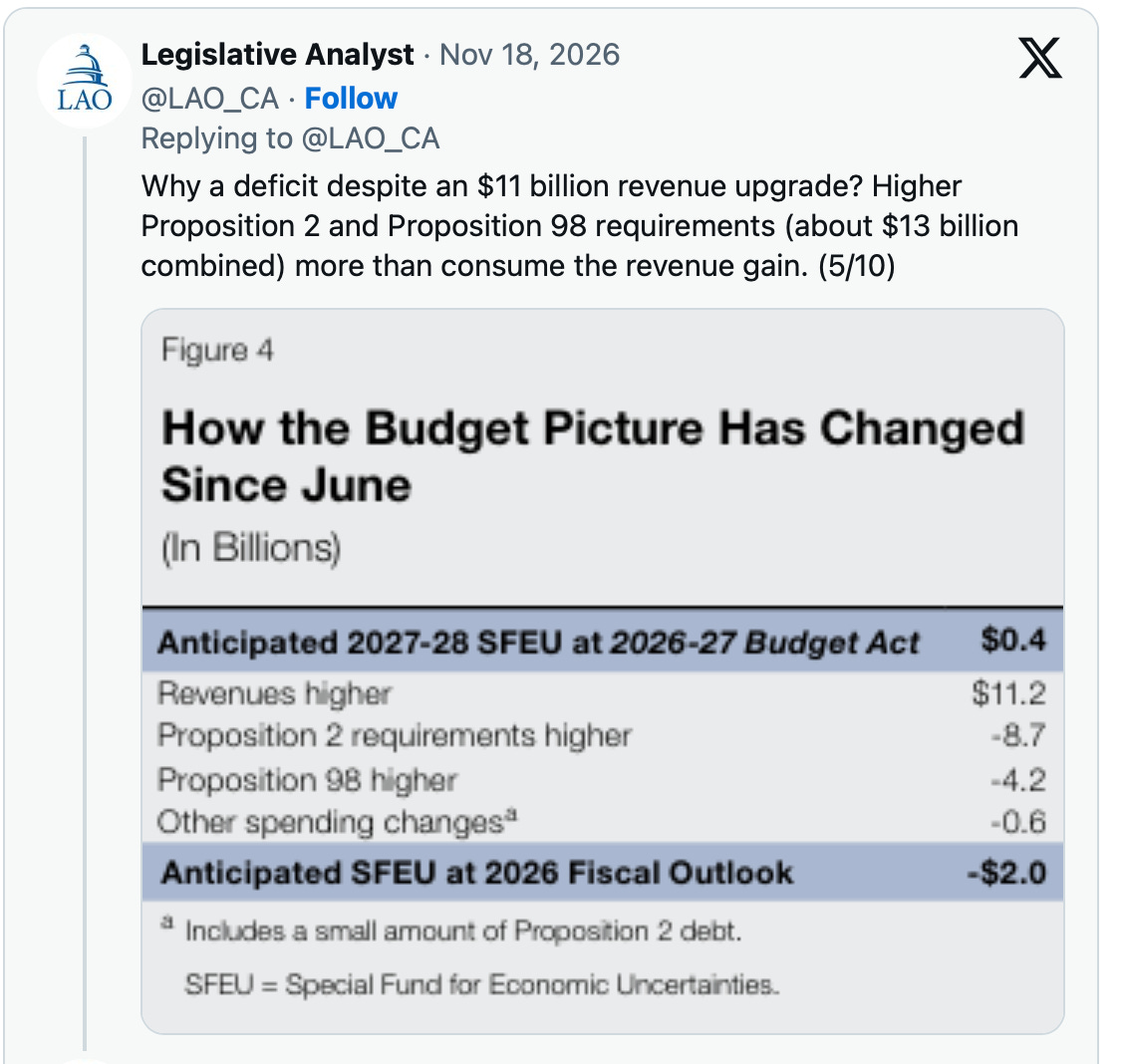
In the stock market crash scenario, personal income tax falls substantially to about $112 billion in 2027-28 versus $141 billion in the base case, producing much larger gaps even after lower Proposition 98 and Proposition 2 requirements.
Specifically, the LAO reports:
Stock Market Poses a Serious Risk to Revenues. Since 2023, the state budget has been the beneficiary of an extended stock market boom. Even now this boom appears to be resulting in continued strength in income tax collections. That said, while the stock market’s recent run has been great for many investors and the state budget, it now appears to have advanced to a dangerous stage. The risk now facing state revenues is that this boom, like many in the past, will abruptly end in a bust.
This Fiscal Outlook Meaningfully Incorporates This Risk. The state must decide how much revenue it can depend on having to pay for current services to Californians who rely on them. We view building a state budget around revenues that do not incorporate the meaningful danger of a market downturn as unduly risky. As such, our Fiscal Outlook explicitly incorporates this risk in two ways. First, to offer some insurance against a stock market downturn, our revenue forecast is somewhat weaker than suggested by recent collection trends, but still well above where it would be if a market crash occurred. This is the forecast we recommend policymakers use as a starting point to reduce the likelihood the state makes commitments it will be unable to afford in the future. Second, to gauge the state’s preparedness for a stock market downturn, we present an estimate of the state’s budget condition under a scenario where the stock market peaks at the end of this year and crashes over the course of 2027.
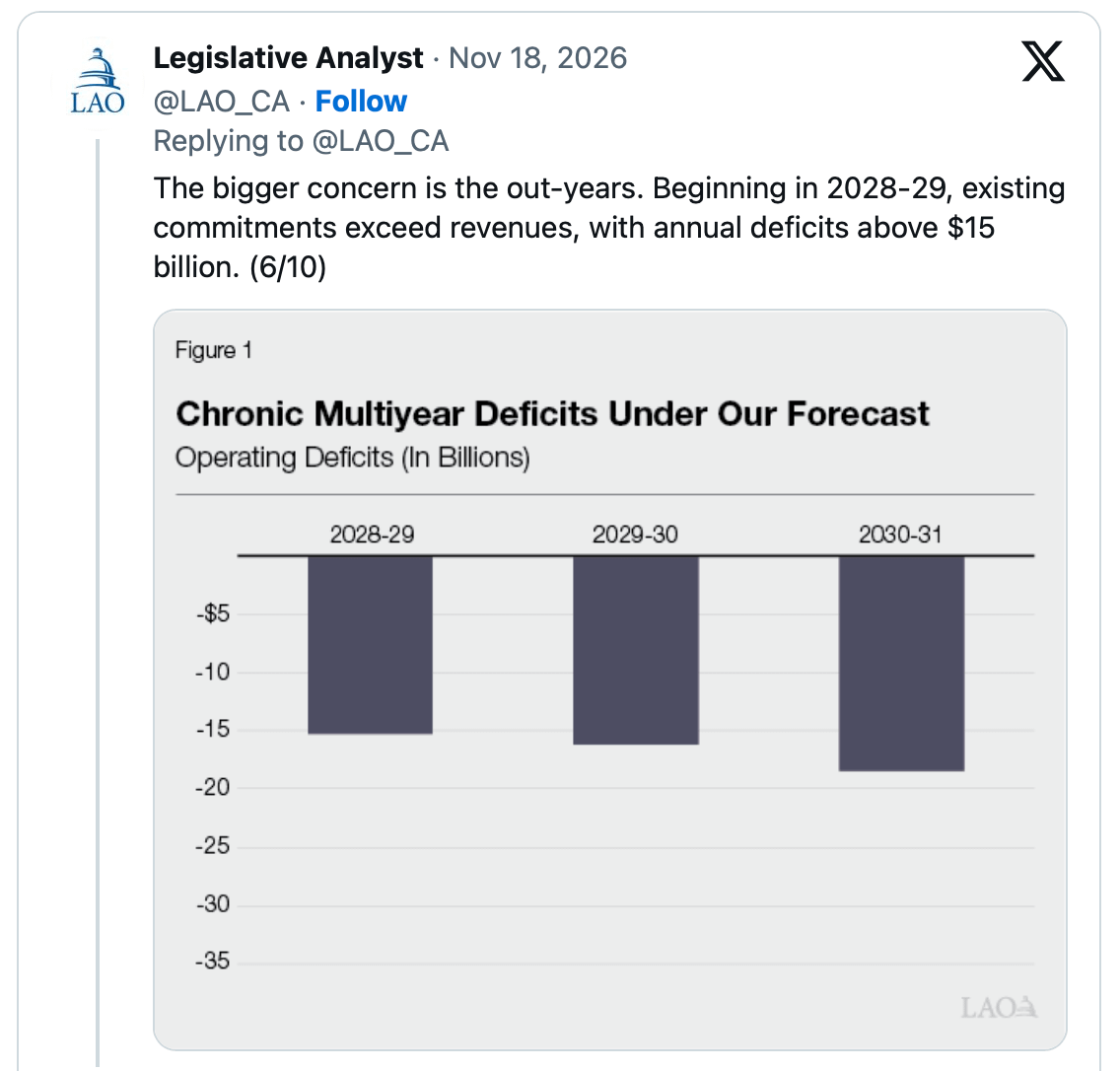
Under Our Forecast, Existing Commitments Exceed Revenues. Under our forecast, there is a small deficit of $2 billion at the end of 2027‑28. Starting in 2028‑29, however, deficits would be considerably larger, as shown on the left side of the figure. Although these out‑year deficits have narrowed from the ones we projected a year ago—mainly due to the artificial intelligence (AI)‑driven stock market surge and ongoing reductions enacted in this year’s budget—deficits persist because the underlying imbalance has not been fully resolved.
This is particularly concerning:
Reserves Not Nearly Sufficient to Cover Shortfalls in the Event of a Stock Market Crash. If the current AI boom is a speculative bubble that ends in a bust, there will be severe budget shortfalls. As the right side of the figure shows, under this scenario, annual deficits would exceed $30 billion. If something like this scenario occurs, the state’s reserves and borrowing capacity will be insufficient, almost certainly necessitating sizeable ongoing cuts or revenue increases within a couple of years.
Senate Republican Leader Roger Niello (R-Fair Oaks) issued a statement today in response:
“The new administration will have to face reality. The stock market returning to more normal levels is a matter of when, not if.
Bringing the state budget into balance in a way that works in good times and bad will help us avoid the pain of making even more drastic changes to Californians’ everyday lives. Otherwise, when the market eventually corrects, the consequences of today’s budget problems will catch up with us.”
This is my shocked face:

*****
Katy Grimes, Editor in Chief of the California Globe, is a veteran Sacramento investigative journalist known for independent, unvarnished coverage of California politics and the Legislature. Originally published November 18 in the California Globe and reprinted with permission. Follow her on Substack.